Welcome to DMS
The Future of Engineering Design, Science, and Innovation
Digital Materials Solutions (DMS) is an innovative engineering consulting company that specializes in multiphysics-multiscale design and development of materials and systems. DMS uses advanced modeling techniques to develop materials and manufacturing processes in extreme environments. We assist mechanical designers, users, and manufacturers in the space, defense, aircraft, automotive, nuclear fission and fusion, and medical fields.
We offer a range of Research and Development (R&D) consulting services. These include development of new material concepts for demanding applications, design concepts for components operating in severe environments, analysis of failure modes, and optimization of system performance and reliability. We work with manufacturers to realize and test our developed material and component designs, and to insert these in emerging technologies. We work with the client to define the R&D need for the development of both material and mechanical design configuration concept. We are unique in combining the expertise with advanced knowledge of material properties and component design at the same time. Thus, we provide system-level solutions, where innovative concepts of materials and their embodiment in mechanical designs are fully integrated for maximum reliability and optimal performance. The following are examples of the key areas supported by DMS.
Multiphysics Design
Multiphysics Design is an emerging field, where design decisions are based on complete product simulation in its operational environments. As the methods improve, and computational power increase, this discipline will gain more momentum as a surrogate for extensive experimental testing and development by trial and error, and as a design tool to achieve system reliability and extend lifetime without costly experimentation. The need for multiphysics design is more acute for materials operating in severe environmental conditions, such as radiation, extreme heat or cold, corrosive environments, erosion due to laser, plasma, or energetic particles, etc. Under these conditions experimental testing can be extremely costly. Multiphysics design can reduce the cost of development and technology insertion. The example below shows a simulation of porous material with interconnected microchannels in response to transient laser heating and fluid flow.

Materials In Extreme Environments
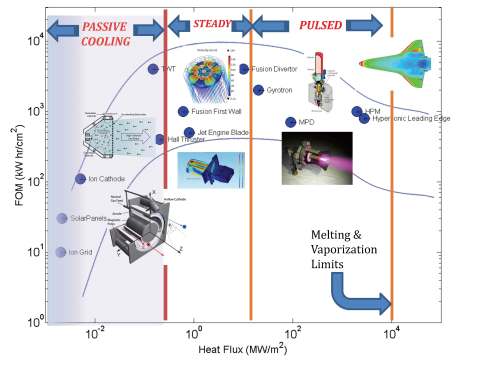
At the end of the day, in many technologies, the limit on viability is material lifetime. This is more true in advanced technical concepts in defence, aerospace, nuclear, automotive, and transportation. The need to generate energy for propulsion, storage, and transmission requires materials that operate at extreme heat flux. Such materials must be designed for maximum lifetime, measured in units of kW.hr/cm2, as shown below. The higher this energy flux before failure, the more economic benefit we obtain from the technology. This is indeed a function of the severity of the heat flux in units of MW/m2, geometric design details, and the way the material is manufactured (meta-materials). The figure below shows the lifetime index (energy fluence) versus the severity index (heat flux).
Multiscale Modeling
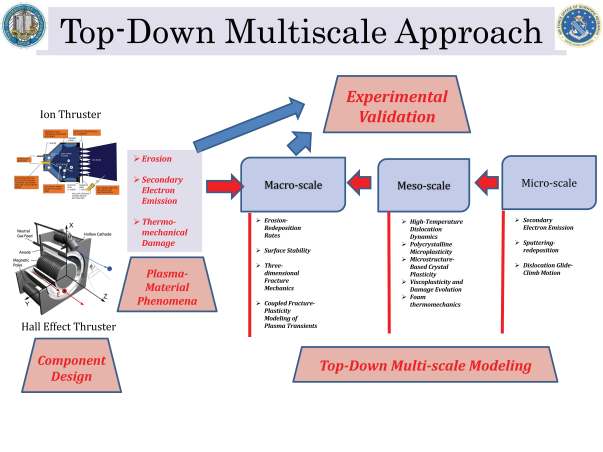
Tremendous progress has been made in the academic world on modeling materials down to the nano-scale. Unfortunately, this knowledge is yet to be transferred to the world of design and manufacturing!! Our approach is to apply a top-down methodology that can be implemented at the current state of computational materials science. We start at the system level with multiphysics modeling to define the boundary and initial conditions for the multiscale methodology. This is is based on solutions of continuum physics equations with appropriate constitutive equations at the macroscopic level, where the parameters are obtained experimentally. Constitutive equations are enriched and verified through more detailed models at the meso-scale (microstructure) and the micro-scale (atomic information). However, realization of the design is not contingent on lower length scale information, but is rather enhanced through experimental data and results from lower length scale models. The approach is illustrated below.
The figure on the right shows mesoscale model of plastic deformation, where dislocation lines represent the boundary between slipped and un-slipped regions of the material. One can see the complex physics of cross-slip and formation of debris that influences further straining of the material. The figure on the left shows the deformation of a polycrystalline material (Cu interconnects for nano-wires in computers, iPhones, etc.) simulated with atomic resolution. The two figures on the bottom show the microscopic nature of plastic deformation in metals, where massive avalanche-like behavior of dislocations control macroscopic strain and failure.



Development of Innovative Materials
As a result of our multiphysics-multiscale modeling and design, several material concepts have been developed. Our experience in the field of “Materials in Severe Environments,” and partnership with Ultramet, a leader in the manufacturing of high temperature materials, has led to many innovative solutions. Recently, we have been developing with Ultramet, refractory metal foam structures for a wide range of applications as heat exchangers, plasma-resilient materials, high heat flux materials, catalysis, etc. We also developed meta-materials with dendritic surface texture for control of photon and particle interaction with surfaces. Another invention is a form of ceramic material with internal interconnected porosity for efficient release of gases and applications in Nuclear Fusion. Our patent is described here: DMS/Ultramet Patent .Examples are shown below.


Applications In Design and Manufacturing
DMS has carried materials development to the stage of component and system development, in collaboration with other partners, such as Ultramet, Boeing, and the ADEPT group. Developed products include design changes in Liquified Natural Gas containers (ADEPT), Heat exchangers for extreme heat flux (Ultramet), insulation of wiring in space systems for protection from cosmic radiation (Boeing), Rocket engine materials (DoD), and insulating materials for hot liquid metals (DOE). Some examples are shown below.
 Digital Materials Solutions